


A lot of parenting lately feels like a word puzzle. Don’t say “good job”; describe what the child did well: “You finished the math problem even though it was very hard!” When our toddler attempts to climb a new part of the playground, we’re not supposed to shout “Be careful!”—we’re supposed to stay quiet. And if we can’t manage that, we’re to offer short, precise direction: “First, place your foot on the beam.” Remember, we’re not telling them what not to do; we’re offering clear instructions! Instead of “Don’t throw sand!” we’re supposed to say, “Sand stays on the ground!”
It seems like everyone has a phrase they’ve adopted and, even more likely, one that sends them over the edge. There’s nothing quite like hearing a mother loudly tell her child (just loud enough for the other mothers to hear), “We don’t hit our friends! Our hands are for helping!” It’s a grand performance of expert parenting, a demonstration that this behavior is an anomaly but not to worry! She knows how to correct it. Of course, the language olympics are much preferable to parents screaming at their kids or, worse, hitting them. But the pressure to say the right thing to these little creatures (who feel no such obligation to use exact language in return) can be a lot to handle on a good day. And anyone who has been to a playground an hour before lunchtime knows that “good day” is a relative term.
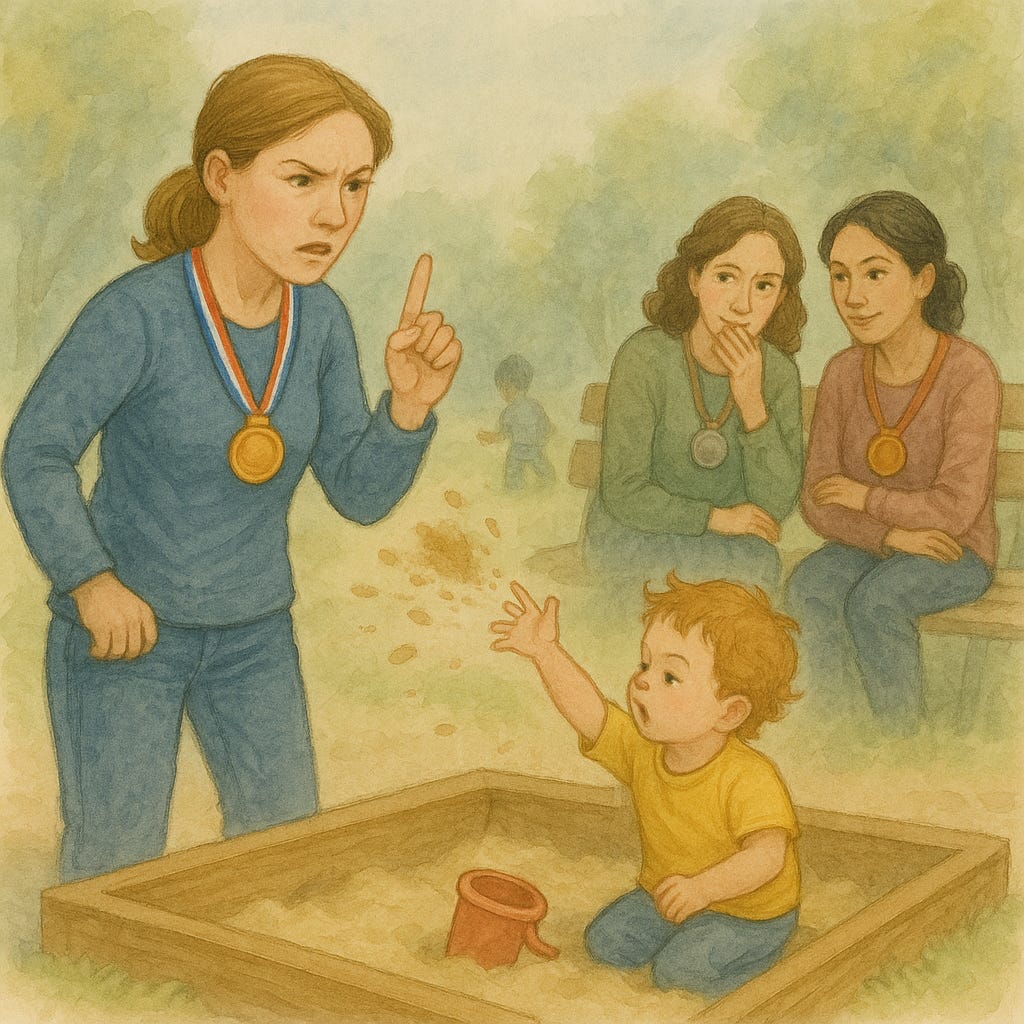
While these little phrases probably originated from some overworked PhD student’s research that they spent nights crying over, they mostly appear to come from Instagram educators whose professional backgrounds are in marketing—or being Amazon sales associates. It can be hard to parse out what’s meaningful advice and what’s content slop designed to feed an algorithm rather than make a difference in the real world.
The book How to Talk So Kids Will Listen & Listen So Kids Will Talk by Adele Faber and Elaine Mazlish does the best job I’ve seen of translating these abstract philosophies into practical interventions that make real change in family life. Even still, it’s hard to hold onto guiding principles while a small child (or their parent) is mid-meltdown. At some point, you have to ask yourself whether the mental gymnastics are worth it. What’s the difference between “you are okay” and “you will be okay” while your three-year-old sobs that they don’t want their flu shot?
As a therapist working with adults, I often think about this kind of language through the lens of reparenting—a therapeutic approach in which individuals learn to meet the emotional needs that went unmet in childhood. Reparenting asks us to speak to ourselves in the tone we once needed to hear: steady, patient, and kind. It’s the process of developing an internal parent who can soothe, guide, and affirm, especially when the outer one was absent, inconsistent, or critical.
In practice, that might mean replacing “I can’t handle this” with “This is hard, but I’m safe.” It’s the same structure we use with children: moving from fear to agency, from helplessness to self-trust. And it’s striking how often adults—successful, competent adults—struggle to find that language for themselves. They can solve complex problems, run companies, and raise children, but can’t tell themselves “You’re doing your best” without hesitation.
When I zoom out, I think that’s the point of all this linguistic gymnastics. We’re not just narrating playground safety or sharing struggles—we’re building a language of selfhood. The phrases we repeat to our children are not just about behavior; they become the scaffolding for how they understand challenge, frustration, and failure. Every time we replace “Be careful!” with “Trust your body,” or “Don’t cry” with “It’s okay to be sad,” we’re laying tracks for how they’ll eventually speak to themselves when no one else is around.